In the Middle East, where summer temperatures frequently exceed 45°C, achieving effective indoor thermal comfort is not just a design requirement—it is a business necessity. Efficient HVAC performance directly influences occupant wellbeing, energy consumption, and operational costs across commercial buildings, malls, airports, hotels, and residential developments.
As advanced engineering tools become essential for optimising HVAC systems, ANSYS Fluent is now one of the most powerful CFD platforms used to predict, analyse, and enhance thermal comfort in complex indoor environments.
In this article, we explore how thermal comfort studies using ANSYS Fluent help Middle Eastern projects achieve superior cooling performance, reduced energy use, and compliant indoor environments.
Why Thermal Comfort is a Challenge in the Middle East
Buildings in the UAE, Saudi Arabia, Qatar, Kuwait, and Oman operate under some of the harshest climatic conditions in the world:
- High outdoor dry-bulb temperatures (often 42–50°C in summer)
- Elevated humidity levels, stressing cooling systems
- Large indoor spaces like malls, airports, and atriums with complex airflow patterns
- High occupancy levels, increasing internal heat loads
- Strict comfort expectations in hospitality and retail sectors
Traditional HVAC design calculations often fail to capture these complexities. This is where CFD-based thermal comfort analysis becomes essential.
What Is Thermal Comfort Analysis in ANSYS Fluent?
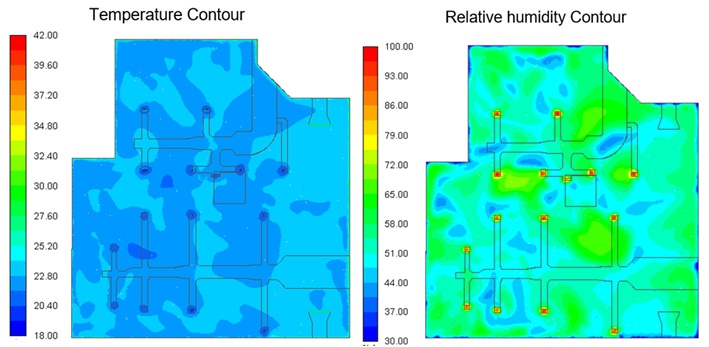
ANSYS Fluent simulates airflow behaviour, temperature distribution, turbulence, and human comfort parameters inside a building. Using detailed 3D modelling, it predicts:
- Air temperature distribution
- Air velocity and draught levels
- Relative humidity
- Radiant heat exchange from surfaces
- Thermal stratification
- Effectiveness of supply air distribution
These are evaluated using recognised comfort metrics such as:
- PMV (Predicted Mean Vote)
- PPD (Predicted Percentage Dissatisfied)
- Draft Rate (DR)
- CO₂ concentration in occupied zones
- ASHRAE 55 & ISO 7730 performance indicators
How ANSYS Fluent Helps Optimise HVAC Performance
1. Identifying Hot Spots and Poor Air Distribution
CFD helps engineers visualise areas where cooling is insufficient or where warm air accumulates. This is common in:
- Food courts
- Open office spaces
- Hotel lobbies
- Retail areas with high glazing
2. Evaluating Supply Air Diffuser Placement
Using Fluent, engineers can test:
- Linear diffusers
- Jet nozzles
- Swirl diffusers
- Grilles supplying fresh air
and identify the diffuser types and angles that deliver the best comfort.
3. Checking the Efficiency of Underfloor Air Distribution (UFAD)
UFAD is becoming more popular in the region, especially in offices. Fluent accurately predicts plume behaviour and stratification.
4. Assessing the Impact of Occupants and Equipment
Internal loads from people, lighting, kitchen equipment, and electronics are modelled to understand their effect on cooling demand.
5. Energy Optimisation
CFD avoids unnecessary oversizing by validating if airflows and temperatures meet comfort requirements with lower airflows or optimised setpoints, reducing energy consumption.
Where Thermal Comfort CFD Is Commonly Used
- Airports and transport hubs
To optimise cooling in large halls, check-in areas, and terminal lounges.
- Retail and commercial malls
To improve comfort in atriums, food courts, and high-traffic areas.
- Hospitality & residential buildings
To enhance guest experience and energy efficiency.
- Industrial and data centres
To ensure safe and comfortable working conditions.
- Offices and educational facilities
To evaluate occupant comfort and ventilation effectiveness.
Why ANSYS Fluent Is the Preferred Tool
ANSYS Fluent offers several advantages for Middle Eastern building projects:
- High-resolution meshing for large indoor spaces
- Robust turbulence models (k-ε, k-ω SST, LES)
- Radiation modelling for solar gain-heavy environments
- Customisable UDFs for control logic and HVAC system behaviour
- Faster iteration times using parallel processing and HPC
- Accurate assessment of air temperature, humidity, and velocity profiles
These capabilities make it ideal for analysing complex indoor cooling scenarios found in Middle Eastern developments.
Why Thermal Comfort CFD Matters for Developers and Engineers
The benefits extend across the full lifecycle of a project:
- Design optimisation – reduces rework during construction
- Energy reduction – less overcooling and more efficient airflow
- Improved occupant satisfaction
- Reduced complaints in hospitality and retail
- Code compliance and green-building certifications
- Better selection of diffusers and HVAC equipment
In a region where cooling systems account for up to 70% of total building energy use, CFD-driven design offers measurable value.
How Lava Consultants Supports Middle Eastern Clients
At Lava Consultants, we specialise in advanced CFD simulations using ANSYS Fluent. Our team supports:
- Architects
- MEP consultants
- Developers
- Contractors
- Facility managers
We deliver thermal comfort analysis for both new-build and retrofit projects across the UAE, KSA, Qatar, and Oman.
Our expertise includes:
- Full 3D thermal comfort CFD models using ANSYS Fluent
- HVAC diffuser and duct terminal optimisation
- Indoor/outdoor cooling performance assessments
- High-resolution temperature contour and velocity maps
- PMV/PPD comfort index reports
- Tailored recommendations to improve HVAC performance
Need Thermal Comfort CFD Support?
If you are designing or upgrading HVAC systems and want to ensure optimal thermal comfort, our engineers can help.
Get in touch:
📧 admin@lavaconsultants.com
🌐 https://lavaconsultants.com/