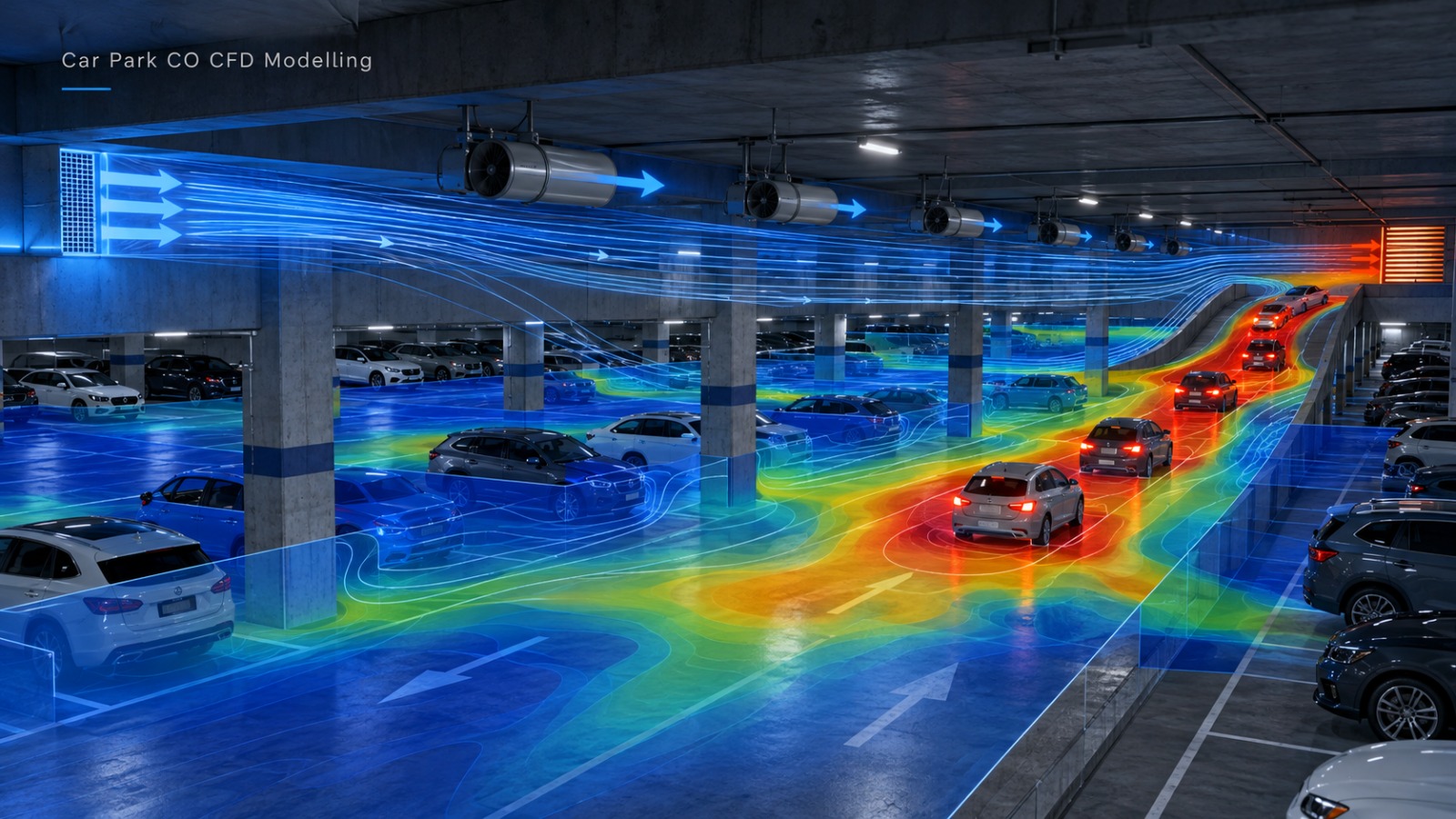
Car Park CO CFD Modelling

Car Park CO CFD Modelling

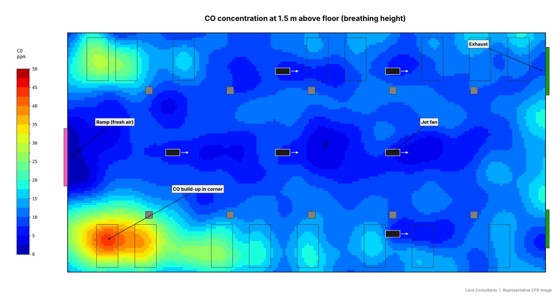
Figure 1 – CO concentration at 1.5 m, showing build-up in a poorly ventilated corner (representative image).

A car park can meet its required ventilation rate and still have pockets of high carbon monoxide (CO).
Air quality depends on more than total airflow. It also depends on where vehicles run, where air comes in and goes out, and how the jet fans move it.
Car park CO CFD modelling tests all of this before the system is built. For basement and podium car parks across the UAE, it is one of the clearest ways to show that the ventilation keeps CO under control in everyday use.

Why Total Airflow Alone Is Not Enough

Two car parks with the same airflow rate can behave very differently. Even a well-sized system can have:
•Fresh air short-circuiting straight to the extract;
• Corners and ramps where the air barely moves; or
• CO building up along walkways and exit queues.
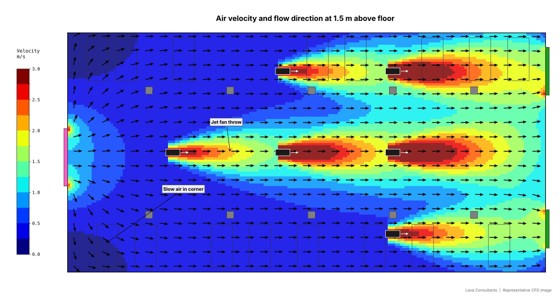
Jet fans do not remove CO. They only push air towards the extracts, so their position and direction matter as much as their number.

What a Good Car Park CO CFD Study Looks At

1. Realistic vehicle emissions

CO levels depend on how many vehicles are running at the design peak, such as the evening rush in an office car park, and the emission rate per vehicle. Cold starts produce far more CO than warm engines, so the mix matters.

2. Emission rates that suit the project

Rates should reflect the local fleet, fuel and design year. Published values, such as those in the ASHRAE Handbook, are dated and should not be copied straight into a current UAE project.
3. Jet fan layout

More jet fans do not always mean better results. A fan in the wrong place can create recirculation or lose its push against a beam.

4. Supply, extract and geometry

If supply and extract points are too close, air takes a shortcut. Beams, columns and ramps can also block airflow, so the model should include them.

Figure 2 – Air velocity and flow direction at 1.5 m (representative image).

Acceptance Criteria: Is the Air Safe to Breathe?

Results are checked at breathing height (about 1.5 m) for peak CO, average CO along walking routes, and how long high levels last.
Criteria and averaging periods are project-specific. For reference, the ASHRAE Handbook – HVAC Applications (2015, Chapter 15) cites 25 ppm over 8 hours and 35 ppm for up to 1 hour. In the UAE, confirm the criteria with the relevant authority. Note that a momentary peak is not an 8-hour average, and road tunnel CO limits do not apply to car parks.

CO Sensors and Demand-Controlled Ventilation

Many car parks run fans at low speed and ramp up when CO sensors detect rising levels, saving significant energy. CFD shows where CO collects first, which guides sensor locations and fan staging.

Use CFD Early – Not Just to Pass Approval

If the first model shows a problem, we test simple fixes – adding, moving or turning jet fans, or relocating an extract – and avoid costly changes on site.
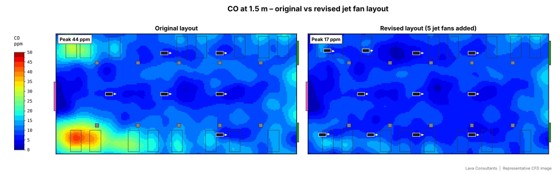
Figure 3 – CO at 1.5 m before and after a revised jet fan layout (representative image).

Frequently Asked Questions

  1. Is CO modelling the same as smoke modelling?
    No. Smoke modelling checks the car park in a fire; CO modelling checks everyday air quality. The same jet fans often do both, but each needs its own scenarios and criteria.
  2. What software do you use?
    ANSYS Fluent for ventilation and CO modelling, and FDS with PyroSim for smoke.
  3. Can you model NO2?
    Yes. Where diesel traffic is significant, NO2 may need its own assessment. Meeting the CO limit does not prove NO2 is acceptable.
  4. What do you need to start?
    Architectural plans, parking layout, ventilation drawings (supply, extract and jet fans), fan data and expected traffic peaks.
  5. Do you work outside Dubai?
    Yes. We work across the UAE, as well as Saudi Arabia, Australia and the UK.

Car Park CO CFD Modelling with Lava Consultants

Lava Consultants is a fire engineering and CFD consultancy with offices in Dubai and Melbourne. Our car park ventilation services include:
• CO and NO2 CFD modelling;
• jet fan layout optimisation;
• CO sensor and demand-controlled ventilation studies; and
• smoke control CFD for Civil Defence submissions.