
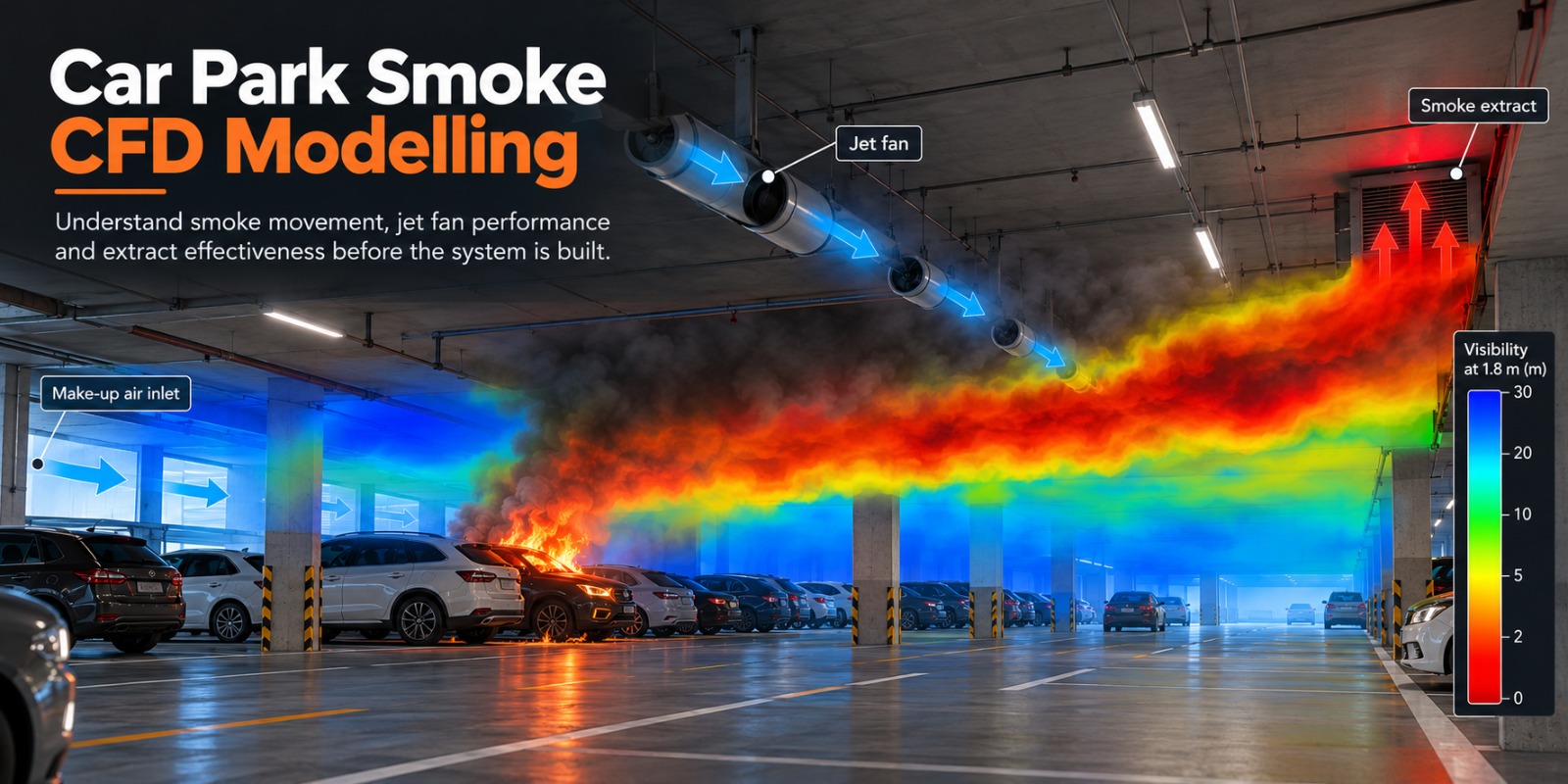
A car park can meet its required smoke extract rate and still fail in a real fire.
That is because smoke control depends on more than fan size. It also depends on where air comes in, where it goes out, how the jet fans push the smoke, and where the fire starts.
Car park smoke CFD modelling lets us test all of this on a computer before the system is built. For basement and podium car parks in Dubai, Abu Dhabi and across the UAE, it is one of the clearest ways to show Civil Defence that a smoke-control design actually works.
Two car parks with the same extract rate can behave very differently. Even a well-sized system can still have:
• Smoke circling back instead of reaching the extract;
• Dead zones where smoke collects;
• Fresh air going straight to the extract without clearing smoke; or
• Smoke pushed towards exits and escape routes.
Jet fans do not remove smoke. They only push it towards the extract points, so their position and direction matter as much as their number. CFD shows how all the parts work together.
Fans and dampers do not start the moment a fire begins. There is a delay for detection and start-up, and smoke is already spreading during that time. The model should follow the actual fire-mode sequence.
For open-sided and podium car parks, wind becomes part of the system. Coastal winds in the UAE can push smoke back into the car park, so the model may need to include the area outside the building.
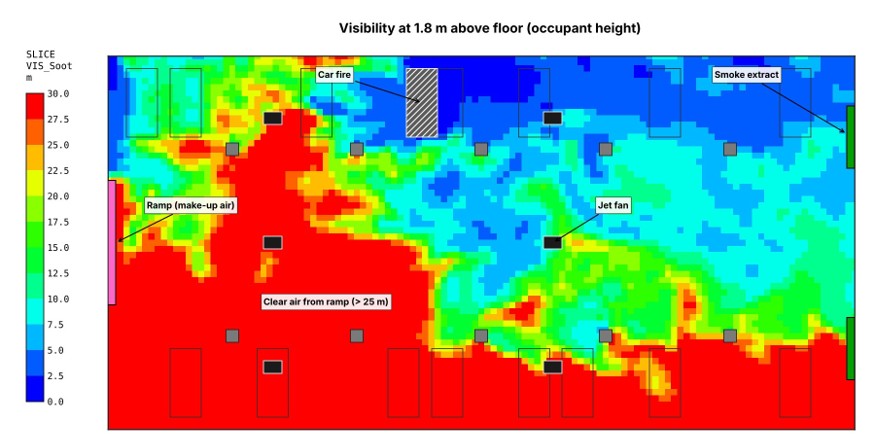
The results should answer one simple question: are conditions safe for people to escape and for firefighters to work? This is checked at head height (usually about 1.8 m) using:
• Visibility – can people see the exits?
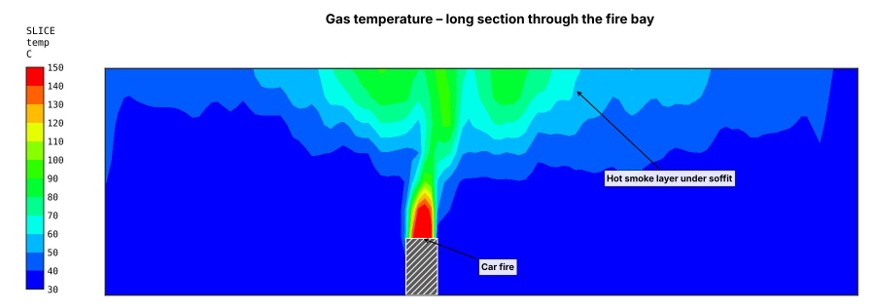
• Temperature – is the air too hot?
• Toxic gases – such as carbon monoxide; and
• Timing – when do conditions become unsafe, if at all?
CFD gives the most value before the design is fixed. If the first model shows a problem, we can test simple fixes – moving a jet fan, adding an extract point or slowing the incoming air – and avoid costly changes on site.
A good CFD report clearly explains the fire scenarios, the assumptions and inputs, the results at head height, and what changes (if any) are recommended, so the design team and the authority can see why the system works.
1.When is CFD needed for a car park in the UAE?
Usually when the car park uses jet fans, when the design does not follow prescriptive code requirements, or when Civil Defence asks for a performance-based assessment. Confirm this early in design.
2.What software do you use?
We use FDS (Fire Dynamics Simulator) with PyroSim for smoke modelling, and Pathfinder where evacuation modelling is needed.
3.What do you need to start?
Architectural plans and sections, the fire strategy, ventilation drawings (extract, make-up air and jet fans), the fire-mode cause-and-effect matrix, and any authority comments.
4.Do you work outside Dubai?
Yes. We work across Dubai, Abu Dhabi, Sharjah and the rest of the UAE, as well as Saudi Arabia, Australia and the UK.
Lava Consultants is a fire engineering and CFD consultancy with offices in Dubai and Melbourne. We have modelled fire and smoke on major metro, rail, tunnel and building projects across the Middle East and Australia. Our car park services include:
• Jet fan and smoke extract CFD modelling;
• Basement, podium and open car park assessments;
• EV charging car park fire scenarios;
• Tenability reports for Civil Defence submissions; and
• Evacuation modelling.

© 2025 Lava Consultants. All rights reserved